|
Communities
Alexander
Bison
LaCrosse
Liebenthal
Loretto
McCracken
Nekoma
Otis
Rush Center
Shaffer
Timken
|
|
RUSH COUNTY
Organized 5 December 1874
Most of the following historical accounts of Rush County and its cities were taken from "The 100 Year Rush", published by the Rush County News in 1974, and, "Rush County, Kansas.A Century in Story & Pictures", published by the Rush County Historical Society, 1976.
"In 1869 the first settlers in Rush County lived along the Walnut Creek near a trading post and stockade on the Fort Hays-Fort Dodge Trail, (now) the present town of Alexander. The prairie was active with coyotes, buffalo, deer, pheasants, and prairie chickens. By 1874, the area from Walnut City west to Alexander, was a bustling community of young settlers who were under the protection of the cavalry units of Fort Larned, Fort Hays, Fort Dodge, and Fort Scott.
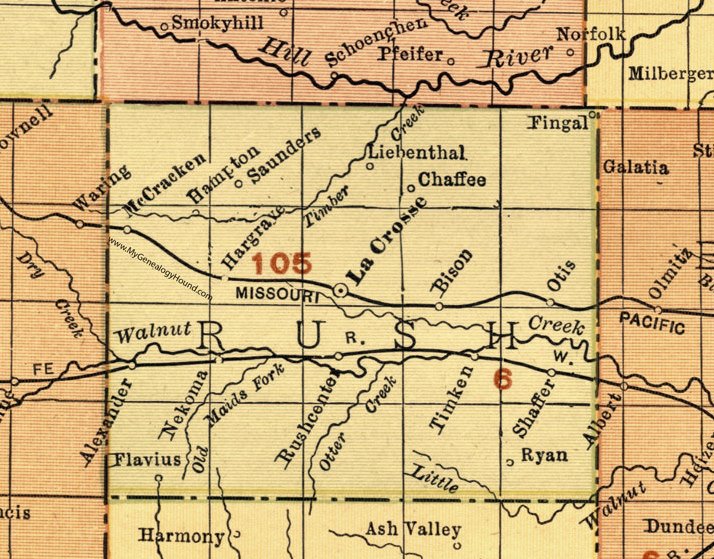
Rush County was surveyed in 1867 and organized on December 5, 1874 by Kansas Governor Thomas Osborn. The county was named in honor of Captain Alexander Rush, Company H of the 2nd Kansas Colored Infantry. P.C. Dixon filed the first claim in Rush County and settled on the banks of the Walnut Creek near present day Rush Center in 1870 receiving his grant from the land office in Salina in 1871. The first deed in Rush County was recorded in March 1875.
Walnut City was designated as the county seat and the city's name was changed to Rush Center. Within two years the county was re-surveyed and the southern tier of townships was given to neighboring Pawnee County in 1876. This changed the center of the county from Rush Center to LaCrosse. A conflict arose between the two towns when the county records were moved to LaCrosse as the intended county seat. The records were moved back and forth by wagon, amidst threats and gunfire, for years. However, no one was killed. LaCrosse was finally declared the permanent county seat and the present courthouse was erected in 1888.
In the 1880 census the 5,490 citizens of Rush County were well-educated, well-bred, young people who came from throughout the United States(4,275), Great Britain(133), Germany(178), Austria(72), Sweden(22), Bohemia(25), Canada(22), and Russia (763). There were 35 types of occupations listed, including 1,145 farmers, and one shipbuilder. Rush County was settled primarily by "persons of quality" who enriched this new frontier with their cultures. Women dressed in the latest fashions.
The Walnut City Daily News, July 1, 1887, reports: "Rush County does not number one pauper among her 8000 inhabitants; the prisons of the state or county do not contain a single one of our citizens, and her court dockets are as small as those of any county in the state. We challenge any county in the state to make a better showing."
Alexander
est. 1869
Alexander was founded in 1869 as a trading post and is the oldest town in Rush County, being settled five years before the county was created. The trading post, called "Harvey's Ranch", was established in 1868 by Alexander Harvey, a soldier in General Custer's 6th Cavalry during his 1868 campaign, and in whose honor the town is named. The post was located on the north bank of the Walnut Creek on the Fort Hays-Fort Dodge Military Trail and served as a refuge for cavalry, freighters, surveyors, hunters, trappers, traders, and travelers, as they worked their way along the trail. The stockade that surrounded the post was a protection against renegade Whites, Indians, and other prairie wildlife.
The first settlers were the J. C. Young family who came in 1872 from Pennsylvania. The first schoolhouse in the region was made of logs from the trees along the Walnut Creek. Public meetings, Bible school and prayer meetings, were conducted in this school house. The first mail service was carried by train to the "end of line depot" where it was transferred to stagecoach and carried along the Fort Hays-Fort Dodge Trail to Alexander.
In 1886 the Santa Fe Railroad was nearing completion in Rush County. At that time, Alexander was situated on the north side of Walnut Creek but after a second railroad survey, Alexander relocated on the south bank of the Walnut and soon businesses flourished in the new location. The year 1909 marked a general building boom with new people moving in from the Eastern and Middle States. The town continued to grow until after World War II.
Today, a plaque located on the west edge of town commemorates the location of Alexander Harvey's Trading Post and the Fort Hays-Fort Dodge Military Trail.
Bison
Incorporated 1911
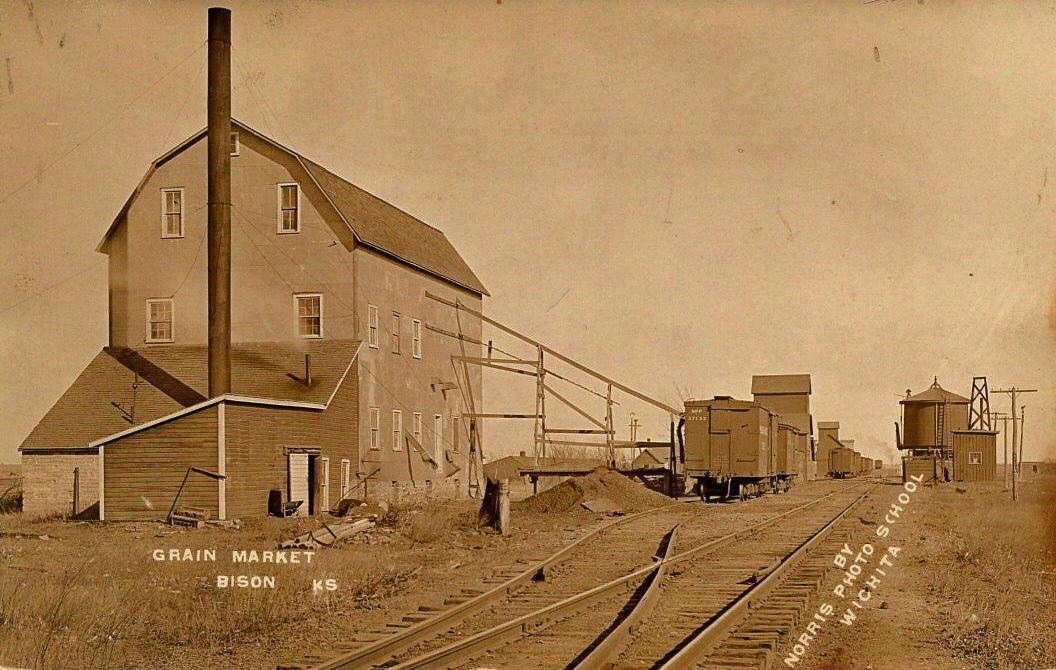
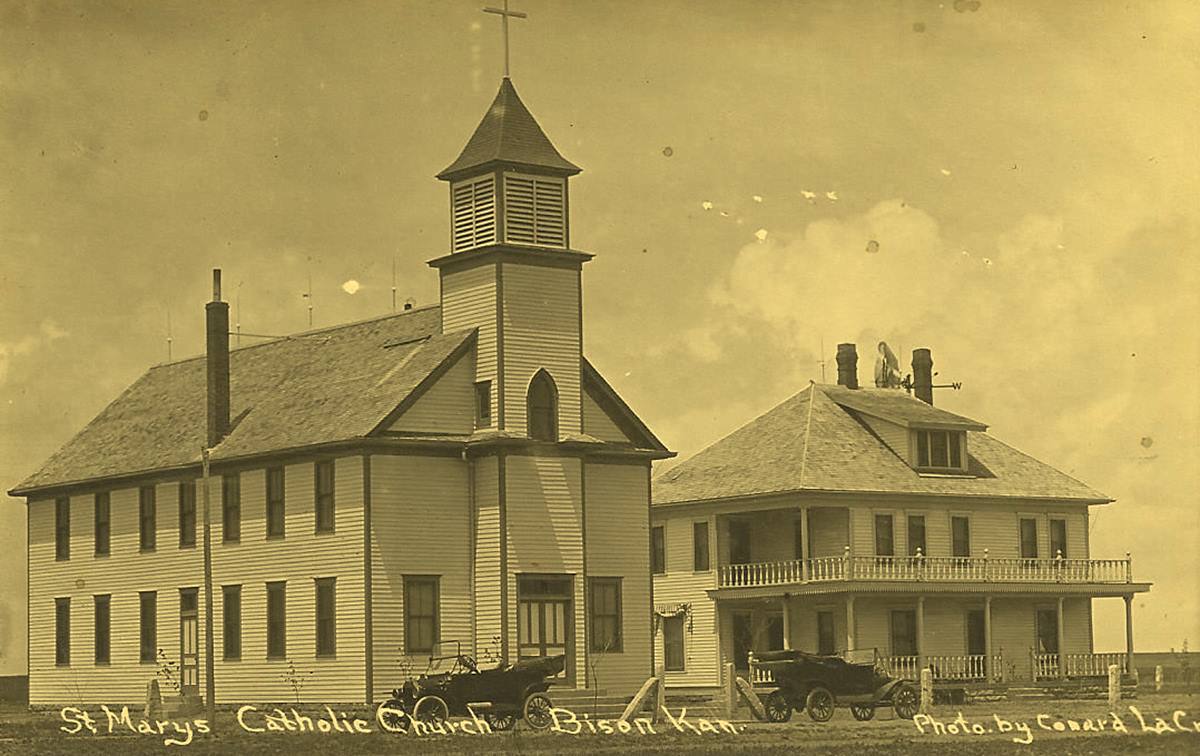
The town of Bison is named in honor of the buffalo, owner of the prairie land before the railroads came. The first homestead was in 1876. The location of Bison was determined by the Missouri-Pacific Railroad Townsite Company. During the spring of 1888 the town site was surveyed and platted.
The Bison Post Office and a general merchandise store opened in July 1888 and Bison continued to grow into a bustling community by the turn of the century. Bison built it's own telephone system very early in it's development.
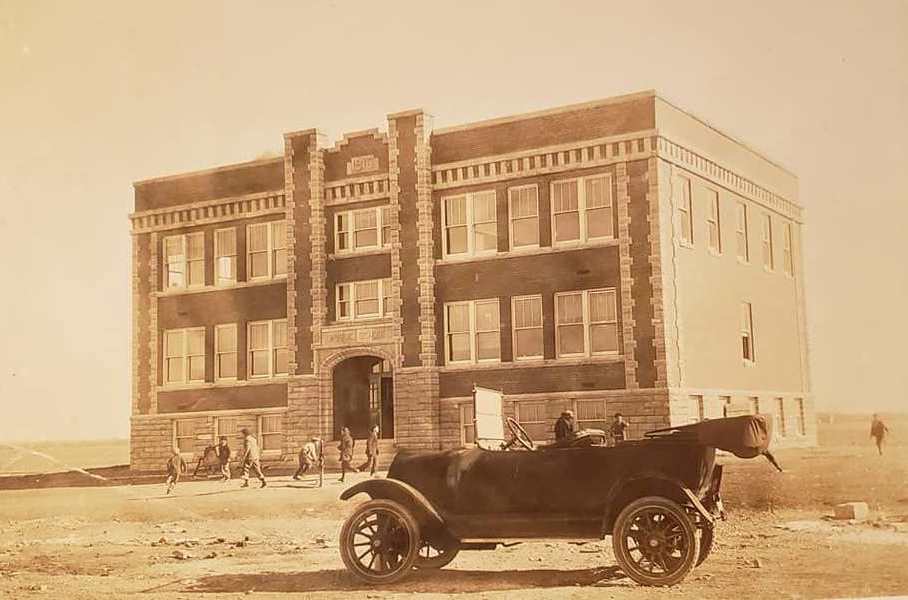
"The first school held in this vicinity was at a farm home in 1877 and the following year the Lone Star German Methodist Episcopal Church and schoolhouse was built of native stone one mile west of Bison. The W.P.A. built a new grade schoolhouse in Bison in 1937. Joseph Tuzicka of Timken dressed the native stone blocks used for the structure. The W.P.A. built the hand dug municipal water well eighteen feet in diameter and sixty-nine feet deep, in 1935, then built the native limestone Bison City Hall over the well. Today, the well continues to produce an abundance of water.
The earliest churches in the Bison community were the English Methodist Episcopal, the German Methodist Episcopal, and the German Baptist.
The first gas well drilled in Rush County was at the north edge of Bison in 1903 and reached a depth of 2,000 feet. This marked the beginning of oil and gas development in Rush County.
LaCrosse
Incorporated 1886
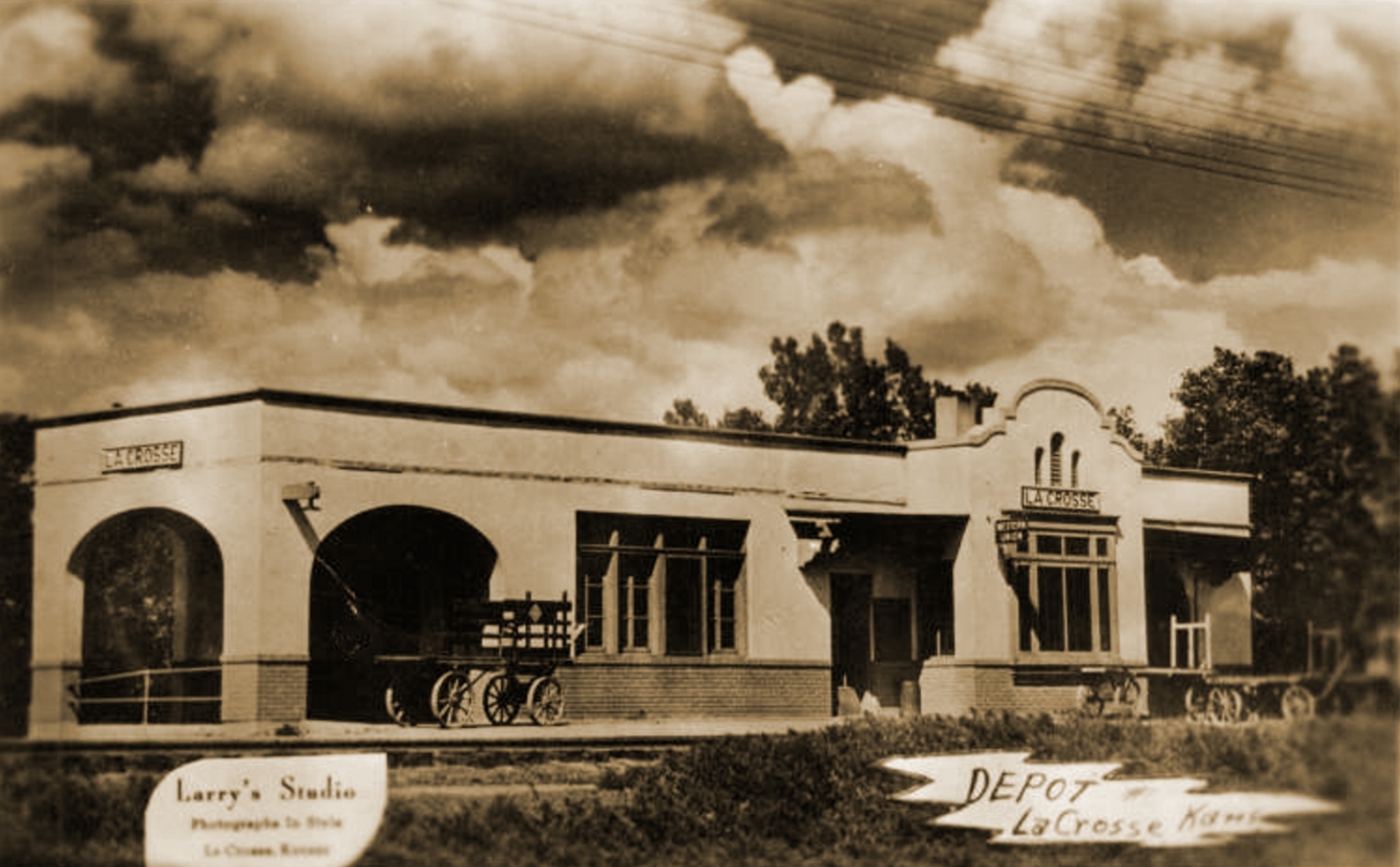
"LaCrosse was filed in 1876 as an original town site by the Missouri-Pacific Railroad when Rush County was re-surveyed two years after it was organized, making this location the exact center of the county. The land belonged to patentee and surveyor, Denman A. Stubbs, and wife, Ellen Jewell Stubbs, who came from Wisconsin and settled in 1874. Sgt. David C. Stubbs, a surveyor and a brother of Denman, applied for a 160 acre patent in 1877 which was granted on June 1, 1878 after David had filed his survey plat, including layout of streets, alleys, and lots, before G.W. Cooley, Register of Deeds of Rush County. John R. Kemmermer, a patentee, recorded his plat in August 1878. These early settlers were the first developers of LaCrosse. Lots in the town were soon sold to young men, mostly members of the Society of Friends, from Pennsylvania, New York, New Jersey, Ohio, Illinois, Wisconsin, and Eastern Kansas.
The county offices were moved to LaCrosse from Rush Center in 1876, much to the dismay of Rush Center's citizens, and (usually) occupied the second story of a stone building on the west side of Main Street, with the court in a small frame building next door. The present court house was built in 1888 and became the permanent home of the county offices. This building is now listed on the National Register of Historic Buildings.
The first LaCrosse school was erected in 1877. The earliest churches in LaCrosse were The United Brethren Church, first known as The LaCrosse Meeting of The Society of Friends, established in 1877; The Christian Church, established in 1887; and The Methodist Church.
LaCrosse is known throughout the nation as the 'Barbed Wire Capital of the World' and hosts the Annual Barbed Wire Convention every spring. The Barbed Wire Museum, The Post Rock Museum, The Rush County Historical Museum, and a plaque honoring Howard R. Barnard (1863-1948), pioneer educator, founder of consolidated schools, and the school bus system, are located in Grass Park (the old Varney homestead) at the south side of town.
Liebenthal
From: "Die Liebenthaler und Ihre Kirche 1776-1976"
Liebenthal, on Big Timber Creek, is one of the oldest of the settlements in Rush County, founded by the immigrants of the Saratov/Volga region of the Ukraine in Russia, who were under the jurisdiction of Francis Joseph I, Austrian Emperor of the Holy Roman Empire. In 1875 the Czar of Russia sent out a decree that the German colonists had lost their 100 years of special privileges and must fulfill the same duties and military obligations as all other Russian citizens.
The colonists arranged to come to the United States, leaving Saratov, Russia, on October 24, 1875, and on November 2, 1875 the first group boarded the steamship, "Ohio", at the Port of Bremen, Germany, landing 21 days later at the Port in Baltimore, Maryland. Of these immigrants, fourteen families, about 60 persons, founded Liebenthal on February 22, 1876. The town was named after Liebenthal (love valley), Russia. The next group of 59 persons came soon after and settled about a half-mile north of the present town. The Liebenthal settlers could not agree and separated into two settlements. One group moved north a few miles and founded Schoenchen, on the south bank of the Smoky Hill River. Both are named after their towns in the Ukraine.
In Liebenthal a little over two acres were donated for a new Roman Catholic church. Church services were held in homes and in the open air, weather permitting, when an itinerate priest would visit the village, or they would drive to Hays for church. The first church was completed in 1878. In the fall of 1889, a parish house was erected and their first parochial school was built in 1897.
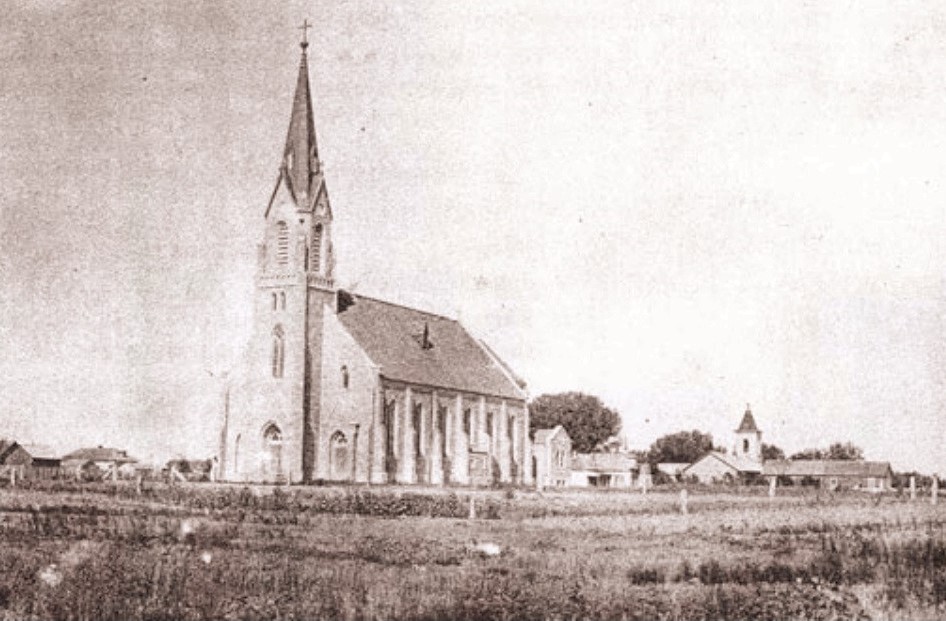
"By the early 1900's, the population had increased to over 500 and a new church was needed. From 1902 until 1905, the members of the parish worked to complete the present native stone church. Over two thousand loads of stone were required. This stone was dug from the nearby hills, moved by wagon, cut and shaped, stacked and set to form the walls of this beautiful building. The project was entirely done by the parishioners. The stained glass windows were made by an Austrian/German artist. Twice fire destroyed all of the wood sections and the roof of the cathedral. It was rebuilt and rededicated in 1921 and 1961 but the interior walls and the altar are no longer as beautiful and ornately fine as before the last fire, however, the original stone walls are those erected by the Liebenthal forefathers. St. Joseph's Kirche stands as one of the most beautiful churches on the Kansas plains.
The Liebenthal cemetery sits on a hill overlooking the town. The tombstones are uniquely like those found under the jurisdiction of the Holy Roman Empire.
Loretto
est 1912
From: "Rush County, Kansas..a century in story and pictures", 1976
The settlers of Loretto came to Rush County in August 1876 from Pfeifer, Russia, situated 75 miles southwest of Saratov, Ukraine, and west of the Volga River. In 1875 three explorers were sent to Kansas to locate a new home for those who would soon leave Russia. They reported that the land in Kansas was good, very much like that in Russia with fertile soil, grass and streams, but with a more moderate climate.
By 1912, seventeen families of the Ellis County settlement of Pfeifer were living just over the county line in Rush County. These families had contributed money toward the construction of a church in Pfeifer with the stipulation that if they decided to establish their own congregation, they could have that money back. Thus, with $3,000 in funds, they decided to build their own church, four and one-half miles south of Pfeifer. Adam S. Urban and Stephen S. Urban each donated five acres of land for the townsite; Martin Urban gave one acre for a cemetery; and Joseph Urban donated land for a church, parsonage, and school. From this, the town of Illinois was born.
In the fall of 1912, a combination church and school was built. It was a two-story structure 60 feet in length and 28 feet in width. Classes were held on the first level, and the second floor served as the church. In 1913, parishioners constructed a rectory.
In 1913, the name of the town was changed from Illinois to Marienfeld, and later, at the recommendation of Father Stutz, renamed Loretto. That year, the townsite was divided into building lots that were sold to raise money for the church. In 1916, there were sixty families living in town and a few years later, the school enrollment peaked at seventy students. At first, laymen taught in the school. In 1918, the Sisters of the Order of the Precious Blood were employed as teachers and a convent was built.
Construction of a new brick church began in the spring of 1927, and in May of 1928, the new
|