History of the Museum
| A Collectors Association is Born
| A Tiny Storefront Becomes a Museum
|
| A New Barbed Wire Battle
| A New Age & a New Society
|
 A Collectors Association is Born
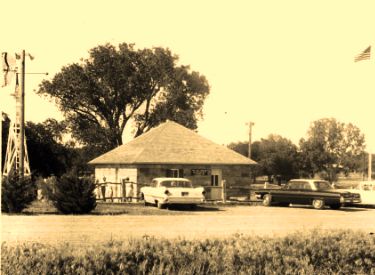 The story of the Kansas Barbed Wire Collectors Association actually begins on May 17, 1964 with the dedication of the
Post Rock Museum in LaCrosse, Kansas. Displayed on the wall above the model quarry was a small, unassuming collection of
40 barbed fence wires. During the first years, museum workers discovered that a growing number of visitors were
inquiring about the small collection. Many of these visitors had collections of their own, some much larger than the
museum’s meager sampling. A bit of research determined that, not only were there hundreds of varieties of this peculiar
fencing material, there were a lot of people who collected it. Opportunity was knocking.
The story of the Kansas Barbed Wire Collectors Association actually begins on May 17, 1964 with the dedication of the
Post Rock Museum in LaCrosse, Kansas. Displayed on the wall above the model quarry was a small, unassuming collection of
40 barbed fence wires. During the first years, museum workers discovered that a growing number of visitors were
inquiring about the small collection. Many of these visitors had collections of their own, some much larger than the
museum’s meager sampling. A bit of research determined that, not only were there hundreds of varieties of this peculiar
fencing material, there were a lot of people who collected it. Opportunity was knocking.
By 1966, the barbed wire hobby, in an organized state, was still in its infancy. A collector’s association had been organized in Texas, a few books had been published, and a history professor had recently been interviewed in the “Wichita Eagle.” According to the “Eagle”, Dr. Ross Taylor, head of the Department of American Civilization at Wichita State University, was a researcher of the history of barbed wire as well as an avid barbed wire collector. The news story brought to light that not only was barbed wire an interesting collectors’ item, it was also a credible part of American history.
With all this interest in barbed wire, three visionary LaCrosse businessmen decided it was time to seize an opportunity. The men met in the office of a local attorney and, over a cup of coffee, discussed bringing collectors of this intriguing fencing material together with the intent of establishing a barbed wire collecting organization in Kansas. The men were: Ivan Krug, LaCrosse attorney; Roy Ehly, Southwestern Bell Telephone manager; and Bill Robbins, local banker. In December 1966, Krug sent a letter to collectors announcing an organizational meeting to be held in January:
“Kansas has nearly 100 known barbed wire collectors. We think this much interest in a fast growing hobby warrants the formation of a state organization. Possibly an annual meeting, or display and swap session should be organized so that those of you just starting would have an opportunity to increase your collections or see what others are doing.”
On Sunday, January 8, 1967 a group of barbed wire collectors met at the LaCrosse Country Club. There were 68 persons in attendance from throughout Kansas and Oklahoma including “the man who invented the machine to mass produce barbed wire.” During the meeting, collectors were given the opportunity to display their collections, discuss the hobby, and swap pieces of barbed wire. Along with ten collections of barbed wire, displays included wire tools, fence tighteners, and what was described as a very special item – a cane made of barbed wire.
That afternoon the Kansas Barbed Wire Collectors Association (KBWCA) was born, the second association of its kind in the United States. The first officers elected were: Ivan Krug, president; Roy Ehly, vice-president; and Bill Robbins, secretary-treasurer. Directors included: Hal Moody, St. George; Francis Cox, Grainfield; Don Wigington, Quinter; Leo Schugart, Hoisington; and Don Stites, Grinnell.
The first decision of the new group was to incorporate as a non-profit organization and establish dues of $5.00 for initiation and $5.00 annually thereafter. Plans were also made to host a special swap and sell session in the spring.
The first KBWCA Swap and Sell show was held on May 6-7, 1967 at the Rush County Fairgrounds in LaCrosse. Show hosts had initially planned for 44 display tables, but by 10:00 a.m. Saturday, they were sold out and had to secure additional tables and display space. Before the show was over, the Exhibit Building was overflowing with displays. Collectors were in attendance from Texas, Oklahoma, Missouri, Nebraska, Colorado, South Dakota, and several towns in Kansas. Between 1500 and 2000 people passed through the fairground gates to exhibit and trade wire, or simply look.
Two “firsts” took place at the LaCrosse show. The World’s Champion Barbed Wire Splicing Contest™ gave contestants a chance to compete against each other to see who could mend a fence in the shortest amount of time with the strongest and tightest splice. J. Delevan Smith, Oklahoma, defeated over a dozen other contestants to claim the title as the first World Champion.
The first Barbed Wire Auction was started as an experiment to show non-collectors the value of some wires. Directors brought a limited number of wires to be sold in traditional auction style. Russell Lohrey of LaCrosse was chosen to be the first barbed wire auctioneer – a tradition he continued every year for forty-eight years until his death in June 2014 with exception of missing two years due to illness. The annual auctions continue to set the value of wires for the entire hobby.
In its first year, the KBWCA had 133 members. In a few years, it grew to nearly 350 members from 18 different states. Magazines across the country ran stories about the hobby. In 1969, Ivan Krug, the local attorney whose office has been referred to as the birthplace of barbed wire collecting in Kansas, made an appearance on The Tonight Show Starring Johnny Carson to talk about the hobby and to give Johnny an opportunity to try his hand at splicing barbed wire. Barbed wire, a once prominent industry that had all but faded into the history books, was once again in the national spotlight.
A Tiny Storefront Becomes a Museum
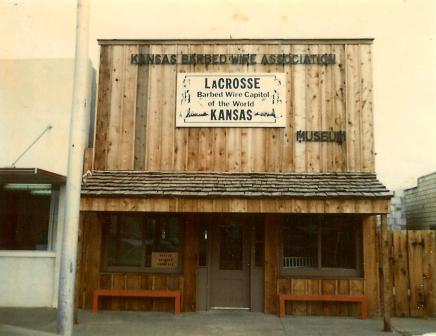 Over the next few years, interest in the hobby continued to grow. Other collectors associations sprang up
across the country. Collectors began to amass huge and valuable collections of barbed wire and related tools.
Some realized a need for a permanent home to exhibit a sampling of these unique collections. Opportunity was
knocking again. The same group of LaCrosse businessmen, along with a few veteran wire collectors, set to work
on a barbed wire museum. At the turn of the decade, the LaCrosse Chamber of Commerce purchased an old
storefront on Main Street and offered the front room to the collectors. News of the unique museum spread
like wildfire. In May of 1970, Charles Kuralt brought his On the Road crew and filmed a segment in LaCrosse
at the yet to be dedicated museum. In May of the following year, the Barbed Wire Museum was officially
dedicated. With barbed wire collecting now synonymous with LaCrosse, the small western Kansas community
became known as The Barbed Wire Capital of the World™.
Over the next few years, interest in the hobby continued to grow. Other collectors associations sprang up
across the country. Collectors began to amass huge and valuable collections of barbed wire and related tools.
Some realized a need for a permanent home to exhibit a sampling of these unique collections. Opportunity was
knocking again. The same group of LaCrosse businessmen, along with a few veteran wire collectors, set to work
on a barbed wire museum. At the turn of the decade, the LaCrosse Chamber of Commerce purchased an old
storefront on Main Street and offered the front room to the collectors. News of the unique museum spread
like wildfire. In May of 1970, Charles Kuralt brought his On the Road crew and filmed a segment in LaCrosse
at the yet to be dedicated museum. In May of the following year, the Barbed Wire Museum was officially
dedicated. With barbed wire collecting now synonymous with LaCrosse, the small western Kansas community
became known as The Barbed Wire Capital of the World™.
By 1990, it became apparent that more space was needed to house several large collections that had been offered to the museum. The downtown museum had only about 500 square feet of display space and that was already filled to capacity. In January of 1990, a new group of local businessmen had a meeting at the Family Castle restaurant in LaCrosse to discuss options to house the growing museum. The best alternative was to construct a 60' x 90' metal building in Grass Park adjacent to the Rush County Historical Museum and Post Rock Museum. Ground breaking was held in May of that year, and exactly one year later the new facility was dedicated debt-free. [More]
 At the same time while the Kansas museum was under construction, another barbed wire museum,
The Devils Rope Museum, was being opened in a former factory in the small town of McLean, Texas.
A Texas newspaper reporter did a story about the two museums opening simultaneously and decided that the
two groups must be feuding. Other papers picked up the story. Representatives from each of the institutions
met and decided to give them what they want and a “friendly feud” ensued. To settle the feud, organizers
planned a gunfight during the 1990 wire show in the Dodge House hotel in Dodge City, Kansas with the victor
claiming the title of Barbed Wire Capital of the World. When the smoke cleared, LaCrosse had retained its
title. News spread and once again the hobby was featured in large newspapers, national magazines such as The Smithsonian, and on the CBS Evening News.
At the same time while the Kansas museum was under construction, another barbed wire museum,
The Devils Rope Museum, was being opened in a former factory in the small town of McLean, Texas.
A Texas newspaper reporter did a story about the two museums opening simultaneously and decided that the
two groups must be feuding. Other papers picked up the story. Representatives from each of the institutions
met and decided to give them what they want and a “friendly feud” ensued. To settle the feud, organizers
planned a gunfight during the 1990 wire show in the Dodge House hotel in Dodge City, Kansas with the victor
claiming the title of Barbed Wire Capital of the World. When the smoke cleared, LaCrosse had retained its
title. News spread and once again the hobby was featured in large newspapers, national magazines such as The Smithsonian, and on the CBS Evening News.
 Over the next decade, the museum continued to grow, but the hobby began to change. Many of the original
collectors had passed away and several others were no longer able to travel to the several wire shows held
each year across the country. The need became apparent for an international association dedicated to the preservation
of the hobby. An organizational meeting was held in Dodge City, Kansas and the Antique Barbed Wire Society
(ABWS) was born. A home base was needed for the new society and LaCrosse became the obvious choice.
Over the next decade, the museum continued to grow, but the hobby began to change. Many of the original
collectors had passed away and several others were no longer able to travel to the several wire shows held
each year across the country. The need became apparent for an international association dedicated to the preservation
of the hobby. An organizational meeting was held in Dodge City, Kansas and the Antique Barbed Wire Society
(ABWS) was born. A home base was needed for the new society and LaCrosse became the obvious choice.
In 2004, an addition to the museum was planned to house collections of the ABWS. In May of 2005, the new facility was completed featuring a research library housing the largest collection of fencing-related materials in existence, a community room, and storage facility.
The Kansas Barbed Wire Museum and the ABWS continue to receive new artifacts for their collections. Thanks to the Internet, the hobby is discovering a previously unknown network of collectors throughout the world. Today, over 40 years later, wire collectors still come from across the United States and occasionally other countries to spend the first weekend in May swapping and selling those 18 inch pieces of American history called Barbed Wire. That ingenious invention designed as a barrier to separate people, now brings them together.